
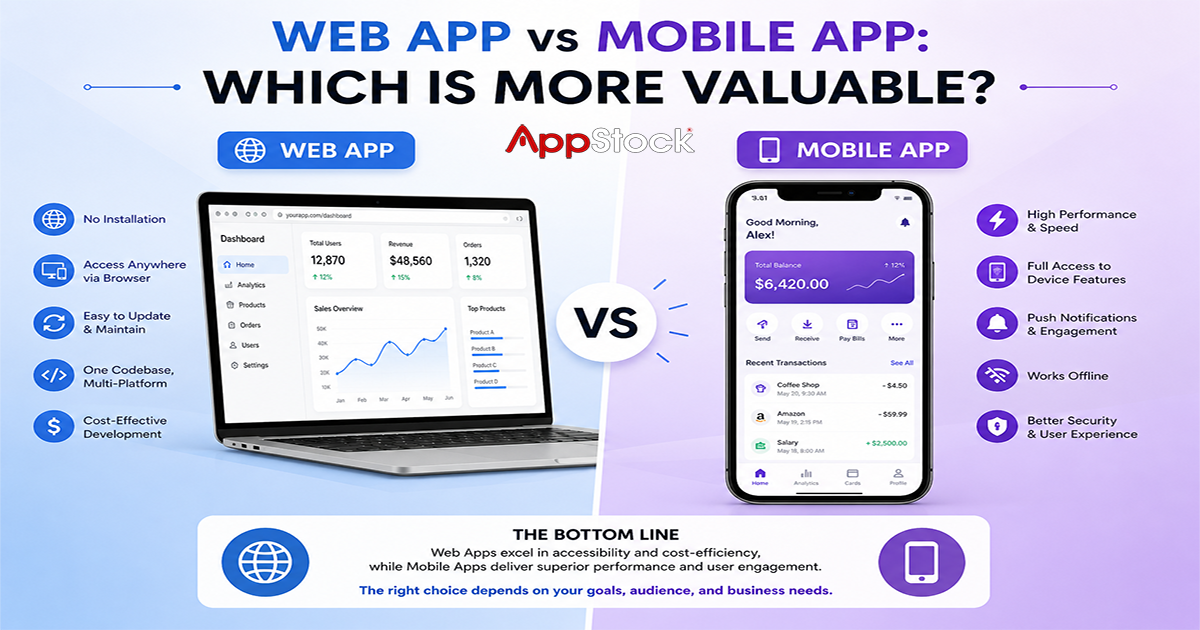
Web App vs Mobile App: Which Is More Valuable?
Compare cost, scalability, monetization, and ROI to determine which app type creates the most long-term value.
Calculate Your App Value →Web app vs mobile app is one of the most important decisions you’ll make when building a digital product.
Most guides compare features. Some compare performance.
But almost none focus on what actually matters: value.
The platform you choose directly impacts your development costs, your revenue model, your scalability, and ultimately how much your app is worth in the market.
If you’re building an app as a business, asset, or investment, understanding this difference is critical.
📊 Why Platform Choice Impacts App Value
Your choice between a web app and a mobile app isn’t just technical—it’s financial.
- Different platforms support different monetization models
- User behavior changes depending on access and convenience
- Scalability and infrastructure costs vary significantly
Two apps generating the same revenue can have completely different valuations based on platform alone.
⚙️ What Is a Web App vs Mobile App?
🌐 Web Apps
Web apps run in a browser and are built using technologies like HTML, JavaScript, and modern frameworks. These are commonly used for SaaS platforms, dashboards, and online tools.
- No installation required
- Accessible from any device
- Instant updates
- Lower development complexity
📱 Mobile Apps
Mobile apps are installed directly onto devices and built specifically for iOS or Android environments.
- Downloaded via app stores
- Higher performance
- Access to device features
- Stronger engagement potential
💰 Development Cost Comparison
Cost plays a major role in determining ROI and overall value.
Web Apps: $3,000 – $50,000+
Mobile Apps: $20,000 – $150,000+
Web apps are generally faster and cheaper to build, allowing developers to validate ideas quickly and reach profitability sooner.
Mobile apps often require separate builds for iOS and Android, increasing both time and cost.
📊 User Behavior: Acquisition vs Engagement
Web Apps
- No install friction
- Instant access via URL
- Higher conversion for first-time users
Mobile Apps
- Higher retention rates
- Push notifications increase engagement
- Daily usage habits
Web apps are better for getting users in the door, while mobile apps are better at keeping them engaged.
💵 Monetization Models
Your revenue model plays a major role in how your app is valued.
Web Apps:
- Subscriptions (SaaS)
- B2B contracts
- Recurring revenue
Mobile Apps:
- In-app purchases
- Advertising revenue
- Freemium upgrades
Key insight: Recurring revenue models typically produce higher valuations due to predictability.
💎 Which App Type Is Worth More?
This is where the difference becomes clear.
- Web apps: typically valued at 3x–10x revenue
- Mobile apps: typically valued at 1x–5x revenue unless they reach massive scale
Why?
- Web apps scale more efficiently
- They rely on recurring revenue
- They often have higher profit margins
In many cases, a smaller SaaS web app can be worth more than a larger mobile app with higher user numbers.
🧮 Calculate Your App’s Value
Your app’s platform is one of the biggest factors affecting its valuation.
Use our App Valuation Tool to get a real estimate based on your app’s data.
🚀 Best Strategy: Start Web, Then Expand
Many successful startups begin as web apps to validate demand and generate revenue quickly.
Once proven, they expand into mobile apps to increase engagement and scale their audience.
This approach minimizes risk while maximizing long-term value.
🔮 The Rise of Hybrid and Web-Based Apps
Technologies like Progressive Web Apps (PWAs) are blurring the line between web and mobile.
These solutions combine accessibility with performance, making them an increasingly attractive option for developers.
📚 Related Guides
Final Thoughts
Choosing between a web app and mobile app isn’t just about technology—it’s about building a valuable asset.
Web apps often win in scalability and revenue predictability, while mobile apps dominate engagement and reach.
The most successful businesses understand how to leverage both.